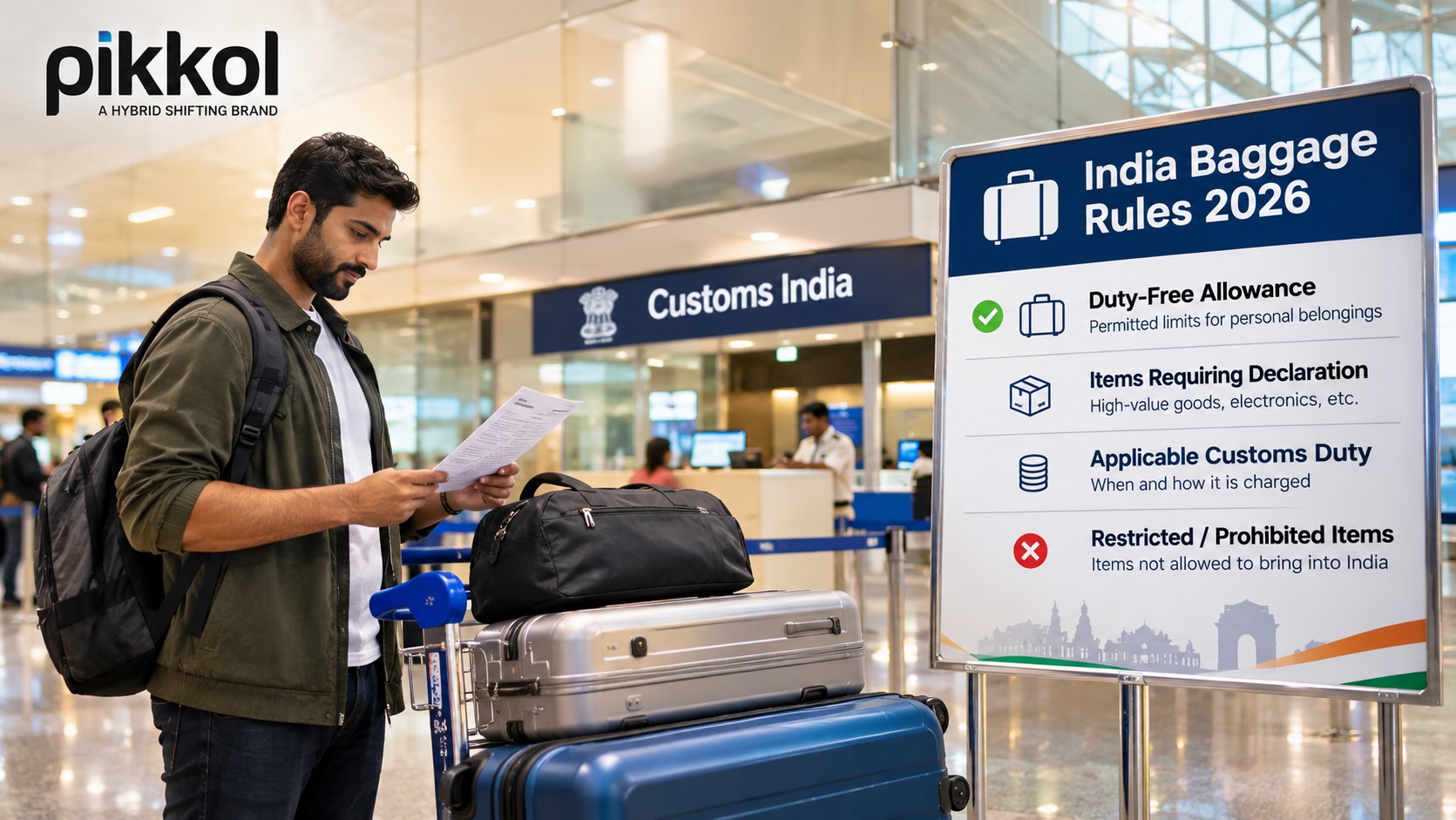
Indias Baggage Rules, 2026 What NRIs Returning Home Need to Know
What Are India’s Baggage Rules, 2026, and What Do They Mean for NRIs Returning Home? The Bag...

Each route has its own guide with ports, transit times, what is worth shipping and route-specific rules.
Moving from another country? The steps below apply to every route. Ask us about your route.
Enter your flight date to get a dated plan.
A planning aid based on typical sea-freight timelines and the Baggage Rules, 2026. Your move manager confirms the dates for your route.
Transfer of Residence (TR) lets people who are moving their home to India bring used personal and household goods without customs duty, up to a value that depends on how long they lived abroad. It applies to Indian residents returning home and to tourists of Indian origin, which the customs FAQs say includes NRIs and OCI cardholders.
| Time you lived abroad | Duty-free value | Conditions |
|---|---|---|
| Less than 3 months | No TR | Only the general free allowance of ₹75,000 applies |
| 3 to 12 months | ₹1,50,000 | None listed |
| At least 1 year in the preceding 2 years | ₹3,00,000 | TR not claimed in the preceding 3 years |
| 2 years or more | ₹7,50,000 | At least 2 years abroad just before arrival; short visits to India in the preceding 2 years no more than 6 months in total; TR not claimed in the preceding 3 years |
Firearms, cartridges beyond 50, cigarettes, cigars or tobacco above the limits, alcohol above two litres, and gold or silver other than ornaments (Annexure I).
Check your TR allowance Guidance only: the customs officer at the port decides.
| Item | Usually | Why |
|---|---|---|
| Furniture you love, books, kitchenware, decor, clothes | Ship | Counts within your TR value; costly or hard to replace with the same quality |
| Large appliances from the USA or Canada | Often sell | Made for 120V/60Hz; India uses 230V/50Hz, so many need a transformer or won’t run properly |
| Appliances from the UK, UAE, Singapore or Australia | Ship if in good condition | Same voltage family (230–240V); still one unit each under TR |
| Laptops, tablets, cameras | Carry | Keep valuables and work devices in hand baggage |
| Cars | Sell | Left-hand-drive cars generally can’t be imported; right-hand-drive cars face strict conditions and very high duty |
| Pets | Plan early | Dogs and cats need an advance No Objection Certificate from Animal Quarantine (AQCS) before travel |
| Documents, jewellery, medicines | Carry | Never in the shipment; jewellery has its own baggage allowance |
| Liquids, aerosols, flammables, food | Leave | Not allowed in household shipments |
| Option | Suits | Things to know |
|---|---|---|
| Full container (20ft or 40ft) | A 2–3 bedroom home (20ft) or a large house (40ft) | Sealed at your home abroad and opened at your door in India; fastest sea option; least handling |
| Shared container | A small apartment or a part load | Costs less for small volumes; waits for consolidation, so it takes longer; goods handled more often |
| Air freight | A few hundred kilos of essentials | About 1–2 weeks; useful alongside a sea shipment for what you need on day one |
Times vary with sailing schedules, transhipment, port congestion, customs examination and inland delivery to your city.
Unaccompanied household goods are declared electronically in Form CBD-II. The declaration can be filed by a person you authorise, so you don't always need to be at the port. Keep these ready; Pikkol's customs team confirms the exact list for your port.
It happens often: a flat still being finished, a rental you will choose after landing, or a few months with family first. Pikkol clears the shipment through customs, moves it to managed household storage, and delivers and unpacks when you are ready. You avoid paying port storage while you decide.
Every move is quoted after a survey, because the price depends on your home and your route:
Why a careful move costs a little more: a single move manager across two countries, export-grade packing, a signed inventory and Pikkol's own crew at your new home mean fewer surprises at the port and on delivery day.
Coming home after years abroad still means paperwork and decisions. Pikkol's settling-in services can help with home search, school search, PAN, banking and mobile connections, and orientation for family members who have never lived in India.
Under the Baggage Rules, 2026 (in force from 2 February 2026), if you lived abroad for 2 years or more you can bring used personal and household goods worth up to ₹7,50,000 duty-free as Transfer of Residence. It is ₹3,00,000 if you lived abroad at least 1 year in the preceding 2 years, and ₹1,50,000 for 3–12 months. The 1-year and 2-year slabs require that you have not claimed TR in the preceding 3 years, and the 2-year slab also limits short visits to India to 6 months in total over the last 2 years.
Yes. The customs FAQs on the Baggage Rules, 2026 state that a “tourist of Indian origin” includes Non-Resident Indians and OCI cardholders, so the same Transfer of Residence slabs apply.
Yes. Unaccompanied baggage can arrive up to two months before you, and should be dispatched to India within one month of your arrival. Customs can extend these periods, and up to one year where you were delayed by circumstances beyond your control.
Not necessarily. The customs declaration (Form CBD-II) for unaccompanied baggage can be filed by a person you authorise. Pikkol's customs team will tell you which original documents they need from you and when.
Often not. North America uses 120V at 60Hz, while India uses 230V at 50Hz, so many appliances need a transformer or will not work properly. Large appliances also use up your TR allowance. Families moving from the UK, UAE, Singapore or Australia, which use 230–240V, can usually ship appliances that are in good condition.
Usually it is not worth it. India drives on the left, so left-hand-drive cars from the USA, Canada or the UAE generally cannot be imported. Right-hand-drive cars face strict conditions and very high duty. Most families sell the car before they leave.
Yes. The Baggage Rules, 2026 list a television among the items allowed under TR, one unit only, within your overall duty-free value. A television is not covered by the general free allowance for ordinary travellers.
Pikkol can clear your shipment through customs, keep it in managed household storage, and deliver and unpack when your home is ready. This also avoids port storage charges if you need more time.
A full container is yours alone: it is sealed at your home abroad and opened at your Indian address, and it is usually faster. A shared container costs less for smaller loads but waits for consolidation and takes longer. Most 2–3 bedroom homes fill a 20ft container; smaller apartments usually go shared.
From the USA or Canada, plan for about 45–75 days door to door by full container and 60–95 days by shared container. Shorter routes, such as from the Gulf or South-East Asia, are usually quicker. Air freight takes about 1–2 weeks and suits a few hundred kilos of essentials.
Book a video survey at a time that suits you, wherever you are. Your move manager will confirm your TR position, the best way to ship and your dates.
What Are India’s Baggage Rules, 2026, and What Do They Mean for NRIs Returning Home? The Bag...

Need extra space at home? Store your furniture and belongings safely with flexible storage solutions...

Create more space at home and keep your valuable belongings organised until you need them again. De...