Top International Moving Co for Easy Global Relocation
Moving to another country is a big life decision. Whether you are relocating for a job, business exp...

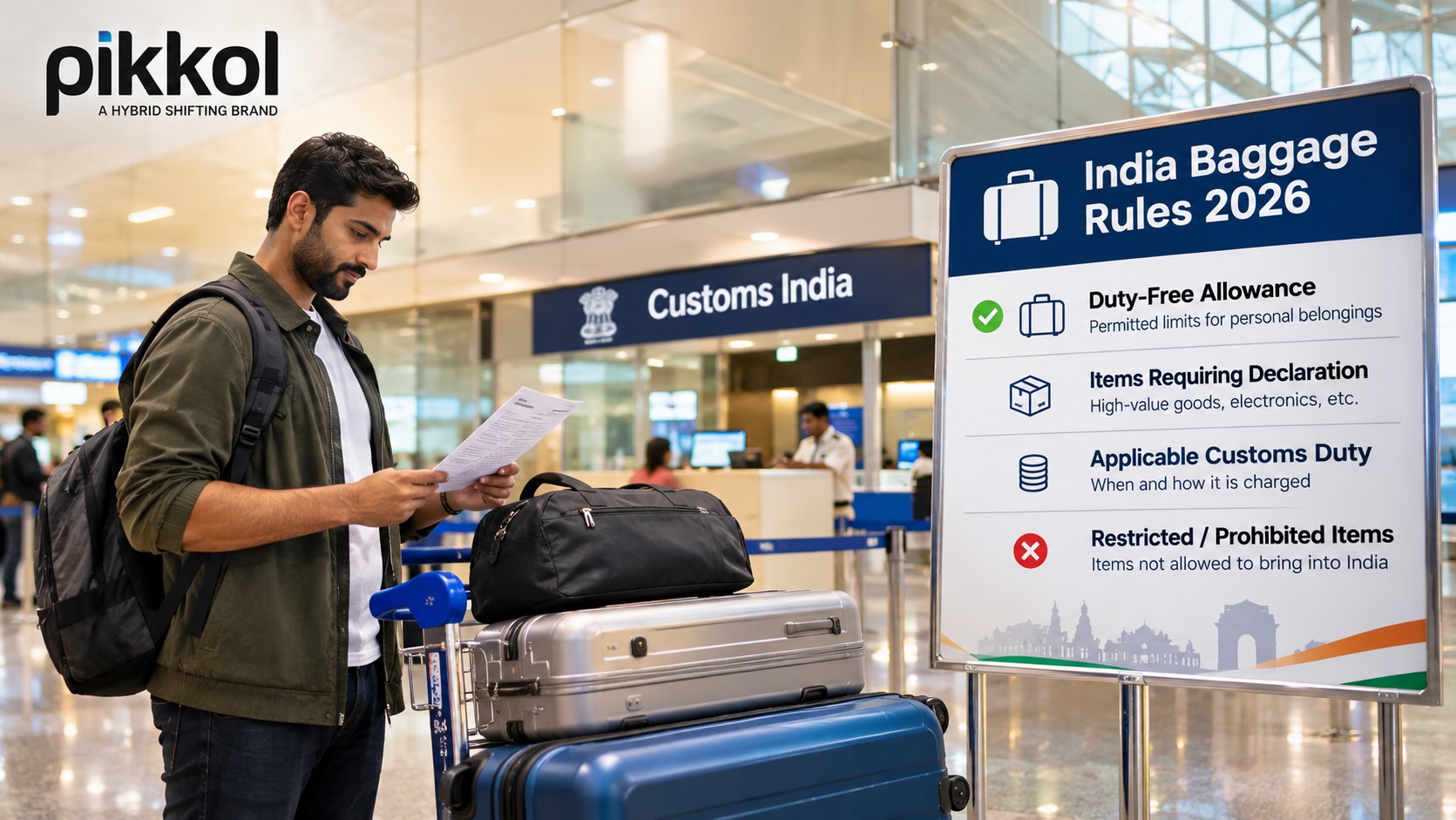
What Are India’s Baggage Rules, 2026, and What Do They Mean for NRIs Returning Home?
The Baggage Rules, 2026 replaced the 2016 rules and took effect on 2 February 2026. They raised the general duty-free allowance to ₹75,000 per adult traveller and increased the Transfer of Residence (TR) limits for NRIs moving back permanently to ₹1.5 lakh (up to 12 months abroad), ₹3 lakh (1 to 2 years) and ₹7.5 lakh (more than 2 years). They also allow one laptop duty-free per adult, let you declare baggage digitally in advance, and allow pets to be brought in duty-free under prescribed rules.
If you’re an NRI planning to come home, these changes affect what you ship, what you sell, and how much you could pay at customs. This guide explains them in plain terms.
The Baggage Rules, 2026 are India’s customs rules for passengers’ personal baggage. They were notified in early 2026 under the Customs Act, 1962, along with new baggage declaration regulations and a Master Circular. They replaced the Baggage Rules, 2016, so any blog, forum post or agent advice still quoting the old ₹50,000 or ₹5 lakh figures is out of date.
The government’s stated aims were less paperwork, more transparency and faster clearance at airports.
| Item | Baggage Rules, 2016 | Baggage Rules, 2026 |
| General duty-free allowance (residents, Indian-origin travellers, foreigners on non-tourist visas) | ₹ 50,000 | ₹ 75,000 |
| Foreign tourists | ₹ 15,000 | ₹ 25,000 |
| Transfer of Residence (2+ years abroad) | Up to ₹5 lakh | Up to ₹7.5 lakh |
| Laptop | Counted in allowance | One laptop duty-free (age 18+) |
| Gold jewellery | Value-based caps | Weight-based allowance |
| Declaration | Mostly paper at the airport | Electronic and advance declaration |
| Pets | Restricted | Duty-free under prescribed rules |
Passengers arriving through land borders do not get the general duty-free allowance.
Every eligible adult can bring goods worth up to ₹75,000 without duty. This is per person. You cannot pool it with a relative’s allowance. It covers gifts and new items you carry, not your used personal effects.
Transfer of Residence is the concession that matters most if you’re moving back for good. It lets you bring used household goods and personal effects with duty relief, up to a value cap based on how long you lived abroad:
| Time Spent Abroad | Duty-Free Household Goods Cap |
| Up to 12 months | ₹1.5 lakh |
| 1 to 2 years | ₹3 lakh |
| More than 2 years | ₹7.5 lakh |
The 2026 rules also replaced the earlier multiple item lists with a single, simplified list of eligible articles, subject to the overall cap.
What this means in practice:
● TR is a capped concession, not a blanket exemption. Goods valued above the cap are subject to customs duty.
● It covers your own used household goods, not trade goods or items for resale.
● It is separate from your ₹75,000 allowance. They are different provisions with different rules.
● Cars are generally not covered by TR. Check import rules separately.
● Laptop: Each passenger aged 18 or above can bring one laptop duty-free, in addition to the general allowance.
● Gold jewellery: The allowance is now weight-based rather than value-based. It is reported as 40 grams for women and 20 grams for other passengers, for those who have stayed abroad for more than one year. Confirm the exact conditions in the notified rules before you travel.
● Pets: Pets can be brought in duty-free under the prescribed rules. If you’re bringing one, start the veterinary and documentation process early. Pikkol’s pet relocation services handle this end to end. If you’re moving from Canada, see their pet relocation page for Edmonton, and for the US, their New York State page.
You can now declare baggage electronically, including in advance. This shortens time at the customs counter and is especially useful when you’re travelling with children, pets or heavy baggage.
If your household goods travel separately from you, timing affects whether they qualify. Sources on the rules describe unaccompanied baggage as needing to ship within a set window before your arrival and land within about two months after it, with limited extensions possible. A missed deadline can mean the shipment clears at full duty, so confirm the exact timing for your situation before booking.
At the airport, your Detained Baggage Receipt helps preserve your claim for goods arriving later.
TR makes shipping more attractive, but it doesn’t make everything worth shipping.
● Ship: Sentimental items, quality cookware, books, clothing, tools, and electronics you rely on.
● Sell or donate: Bulky furniture, mattresses, and large appliances. US-spec 120V appliances often need transformers in India, so many families sell them and buy locally.
● Compare costs: If shipping an item costs more than half its replacement price in India, replacing it is usually smarter.
For a full item-by-item breakdown, read our guide on what to store, ship or sell when you move abroad.
Pikkol’s USA to India relocation guide walks through costs, timelines, customs paperwork and TR under the 2026 rules. If you’re based in a specific US city, see their pages for Texas, California and Philadelphia. Pikkol also offers international relocation services with storage, vehicle shifting and parcel services for items that need to travel separately.
● Using 2016 figures from outdated articles
● Assuming TR means “everything is duty-free”
● Shipping goods that miss the timing window
● Packing resale quantities or commercial goods
● Forgetting that each traveller’s allowance is separate
● Carrying more than one new laptop or several new phones
What are India’s Baggage Rules, 2026?
They are India’s updated customs rules for passenger baggage, effective 2 February 2026. They replaced the 2016 rules and raised duty-free limits, simplified Transfer of Residence benefits and introduced digital declaration.
What is the duty-free allowance for NRIs returning to India in 2026?
The general allowance is ₹75,000 per eligible adult. Separately, NRIs moving back permanently can use Transfer of Residence for household goods up to ₹1.5 lakh, ₹3 lakh or ₹7.5 lakh, depending on time abroad.
Is the ₹7.5 lakh Transfer of Residence limit tax-free for everything?
No. It is a value cap on eligible used household goods. Items above the cap or outside the notified list may attract duty.
Can I bring a laptop to India duty-free?
Yes. One laptop per passenger aged 18 or above is duty-free, separate from the general allowance.
Can I bring my pet to India?
Yes. Pets can be brought in duty-free under the prescribed rules. Documentation and veterinary requirements apply.
Can I declare baggage before I land?
Yes. The 2026 regulations allow electronic and advance declaration.
Are the old 2016 Baggage Rules still valid?
No. They were superseded by the Baggage Rules, 2026.
Can I bring a car under Transfer of Residence?
Generally no. Vehicles are treated separately and attract their own import duties, so compare the cost with buying in India.
Who can help me plan the move?
A relocation specialist can help with packing, inventory, customs paperwork and delivery. Learn more about Pikkol, or request a quote.
The Baggage Rules, 2026 make coming home cheaper and simpler, but only if you plan around the caps and timing. Treat TR as a budget to spend wisely, not a licence to ship everything. Customs rules can change, so confirm the latest figures with the Central Board of Indirect Taxes and Customs (CBIC) before you travel, and ask your relocation partner to check your shipment against them.
Moving to another country is a big life decision. Whether you are relocating for a job, business exp...

A complete guide for Indians planning a smooth and stress-free relocation to Germany. Germany has b...

A Complete Step-by-Step Guide for a Smooth and Stress-Free International Relocation Dubai has becom...